
Best Offroad Shock Absorbers and Lift Kits?
25-08-2025
10:36
Shock absorbers on 4x4s add extra power, and without them, the ride would be very wild. Let's explain this more graphically.
Now, imagine driving without shock absorbers. Every time you hit a bump, the entire impact force hits the wheels and is transferred directly to the suspension coil spring. Without a damping element, the spring's rebound amplitude is transferred directly to the vehicle body, causing intense and constant bouncing. Now, imagine driving such a vehicle on a terrain with potholes everywhere.
Fortunately, you're not interested in such dangerous experiments. Your car is equipped with shock absorbers that absorb the energy of these impacts.
When you're off-road, the terrain constantly pushes your suspension to its limits. If your shock absorbers aren't adequate, the problem isn't just about comfort; it can also affect your safety and control. Therefore, having the right shock absorbers for your vehicle and driving style is crucial. They increase traction, provide a smoother ride, and most importantly, allow you to navigate challenging terrain more safely.
What is a shock absorber made of and how does it work: structure and features
Single-tube and double-tube design
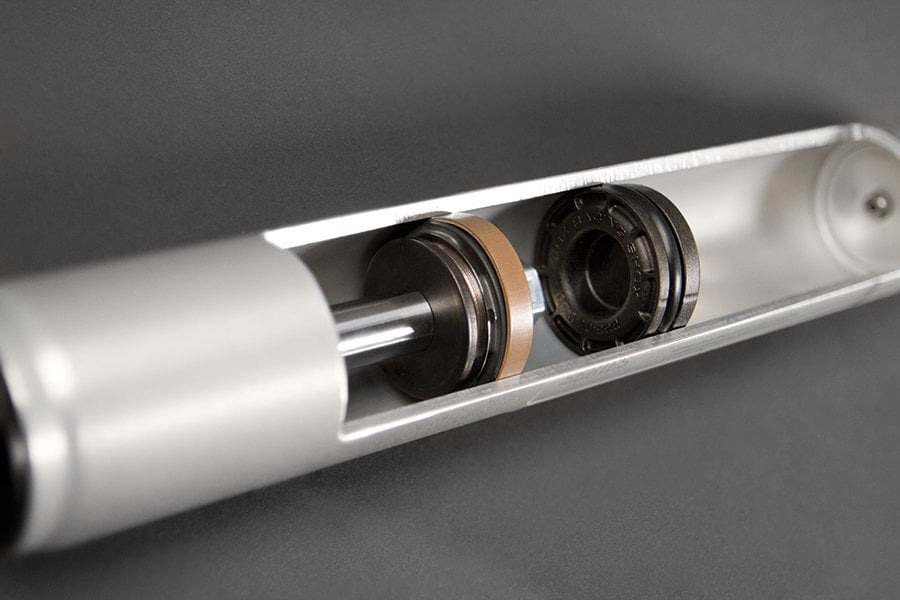
Let's start from the beginning. Shock absorbers are divided into two types, monotube and twintube, based on their design. Twintube shock absorbers are generally less sophisticated, but they reduce the risk of fluid mixing by using an additional internal cylinder. This limits the formation of cavitation, which occurs when air mixes with oil, reducing the shock absorber's efficiency. A monotube shock absorber, on the other hand, overcomes this problem by using an IFP (Internal Floating Piston) gas chamber that separates the nitrogen from the fluid.
These two types of shock absorber designs can provide the performance needed for off-road driving. More specifically, a typical shock absorber consists of:
Top and bottom links
Piston rod
Piston rod guide
Piston rod seal
Piston at the end of the rod
Valve discs on the piston
Outer cylinder (or outer and inner cylinders)
Reservoir
bottom valve
At first glance, a coilover, a spring-loaded shock absorber, may appear different. The difference lies primarily in the shock's connection to the spring. It resembles the McPherson struts found in some front suspension setups, but unlike the McPherson strut, which is part of the steering system, coilovers are solely for damping and suspension stabilization. Pickup truck owners are likely familiar with these.
Shock absorber – travel distance and stiffness
So how does a shock absorber's design translate to real-world performance? When a wheel hits a bump and moves up and down, the shock absorber rod enters the cylinder, displacing the oil inside. In a standard oil-filled shock absorber, fluid flows through the piston bores, bending the valve discs, creating resistance and damping the suspension's vertical vibrations.
If these discs are on both sides of the piston (top and bottom), the shock absorber performs similarly when returning to its starting position. The shock absorber's stiffness depends on the specific properties of these discs or plates.
Thanks to their specific configurations, a shock absorber can vary its stiffness depending on the compression moment. For example, it can offer more resistance during compression and be softer (rebound faster) during extension. Note that this is a simplified explanation, as the same shock absorber behaves differently when cornering than when receiving a hard impact on the wheel.
Which shock absorbers for off-road racing and extreme off-road driving?
If your primary activity is riding on challenging, rough terrain, you might consider installing shock absorbers with more advanced technology. In racing, the target is much closer, so the path to the goal is shorter and faster than in off-road driving. Unless, of course, you're traveling in very mountainous terrain. In either case, there's no time for cooling down and more versatile shock absorber performance is required.
Reservoir Shock Absorbers
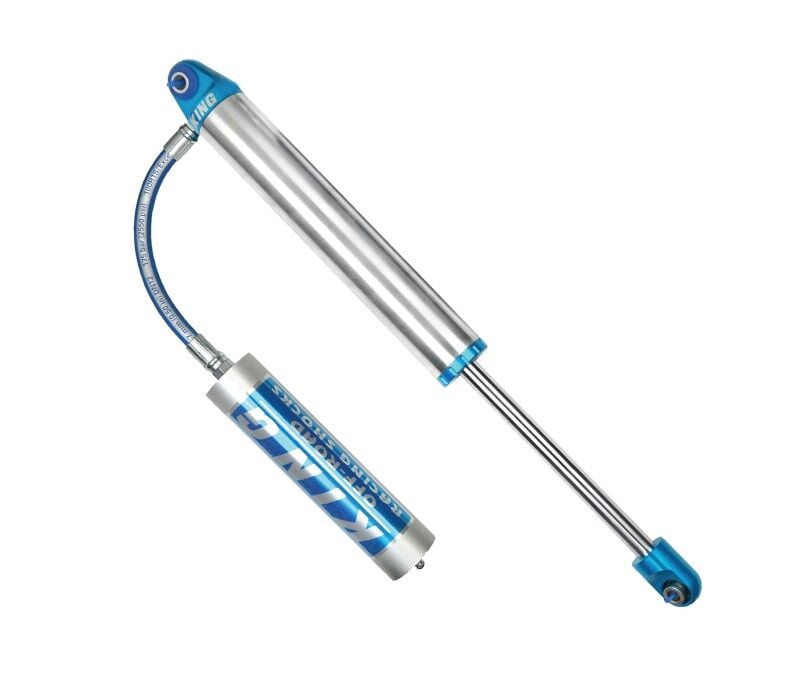
This shock absorber features a dedicated external chamber containing extra oil and a low-pressure nitrogen chamber separated from the fluid by a floating IFP piston. Structurally, it's a variation of the monotube shock absorber, but the absence of the nitrogen chamber offers the designer more calibration options. The lower pressure and potentially longer stroke for the same overall length compared to other models expands the range of possible configurations.